 INTRODUCTION
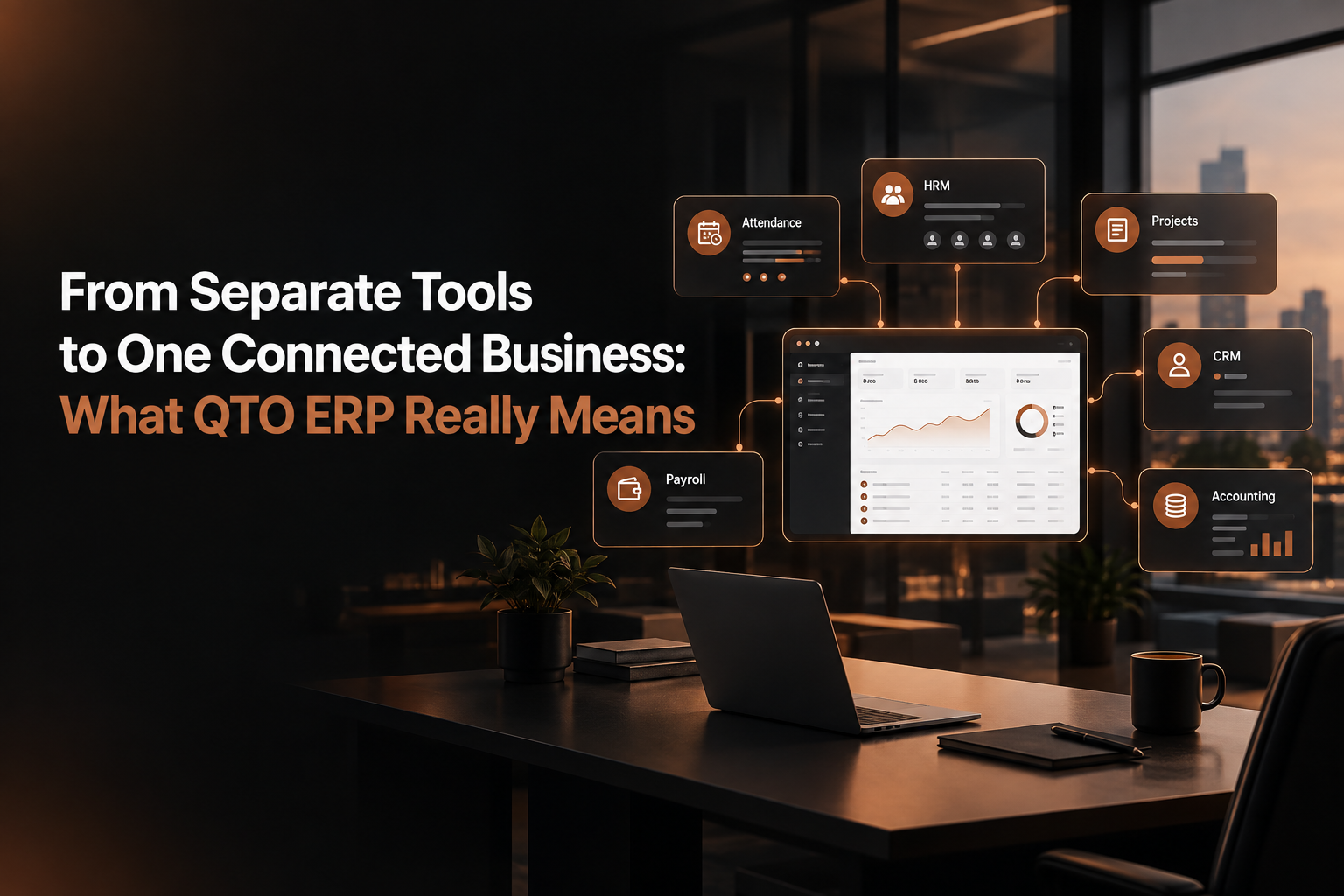
From Separate Tools to One Connected Business: What QTO ERP Really Means
Admin · October 1, 2026 · 5 min read · INTRODUCTION
Discover how ERP connects separate business processes into one centralized system, helping manage employees, projects, customers, payroll, attendance, and accounting more efficiently
Running a business means dealing with many different types of information every day. Employee records, attendance, projects, customer details, salaries, expenses, and financial records all need to be managed properly.
As a business grows, handling these areas through separate tools can become difficult. Information gets spread across different systems, teams may have to enter the same data more than once, and finding the right information can take unnecessary time.
This is where an ERP system comes in.
What Does ERP Mean?
ERP stands for Enterprise Resource Planning. In simple terms, ERP is a way of connecting important business processes through one software platform.
Instead of using one system for attendance, another for customers, another for payroll, and another for accounting, an ERP software platform brings these functions together.
The main idea behind an ERP system is not simply having many features in one place. It is about allowing different parts of a business to work with connected information and workflows.
For example, attendance information can be relevant to payroll, employee information can support HR processes, and project information can help teams manage their daily work.
What Is ERP Software Used For?
ERP software is used to organize and manage business operations through connected modules.
Depending on the ERP solution, these modules can include human resources, attendance, project management, CRM, payroll, accounting, inventory, manufacturing, and other business functions.
This means there is no single definition of what every ERP must contain. Different ERP systems are designed for different businesses and operational needs.
Some well-known ERP platforms include SAP ERP and ERPNext, but businesses can also use purpose-built or customized ERP solutions based on their requirements.
How Does an ERP System Work?
An ERP system works by organizing business functions into modules while keeping them within a connected platform.
For example, an employee may clock in through the Attendance module. That attendance information can then become relevant when salary and payroll are processed.
Similarly, customer information can be managed through CRM while project teams use project management tools to handle delivery.
The purpose is to reduce unnecessary separation between business processes and make information easier to manage.
QTO ERP: One Platform for Core Business Operations
QTO ERP is an ERP software platform designed to bring several important business operations into one connected system.
Rather than presenting ERP as a complicated collection of features, QTO ERP organizes its functionality around practical business areas.
Here are the core modules currently available in the QTO ERP platform:
Module | What It Helps Manage |
Attendance | Clock-ins, clock-outs, working hours, breaks, leave, calendars, shifts |
HRM | Employee and organizational information and HR-related processes |
Project Management | Projects, teams, tasks, workflows, reports, and project performance |
CRM | Leads, accounts, contacts, project sites, and customer-related records |
Salary & Payroll | Salary profiles, payroll calculations, payslips, allowances, deductions. |
Accounting | Accounts, journal entries, ledgers, financial records, and payroll accounting |
Attendance
The Attendance module helps businesses record and manage employee working time. It supports clock in/out, breaks, attendance records, leave requests, calendars, shifts, and related policies.
HRM
The HRM side of QTO ERP helps keep employee and organization information organized. This gives businesses a centralized place for important workforce records and HR operations.
Project Management
Project Management brings projects, teams, tasks, reports, performance views, and workflows into one area. Teams can use it to organize work and keep project activities connected.
CRM
The CRM module is designed for managing customer-related information. It includes leads, companies or accounts, contacts, project sites, and other customer records within the same ERP environment.
Salary & Payroll
Salary and Payroll connects employee compensation with payroll processes. QTO ERP supports salary profiles, attendance-based calculations, payslips, allowances, deductions, bonuses, increments, and other salary-related information.
Accounting
The Accounting module provides tools for managing financial records, including the chart of accounts, journal entries, ledger records, and payroll accounting configuration.
Why Connected Business Operations Matter
The value of an ERP system is not only the number of modules it contains. The bigger benefit comes from having related business information organized within one platform.
When employees, projects, customers, payroll, attendance, and accounting are managed through connected workflows, businesses can spend less time moving information between separate tools and more time using that information.
QTO ERP is built around this connected approach, with access and visibility managed according to user permissions.
Who Built QTO ERP?
QTO ERP is a product developed by QTO Dev, a web development company focused on building digital products and business solutions.
QTO Dev developed QTO ERP as a dedicated ERP product to bring core business operations into one connected platform.
The goal is straightforward: give businesses a structured system where their people, projects, customers, payroll, attendance, and accounting can work together instead of remaining scattered across different tools.
Final Thoughts
ERP does not simply mean putting many features under one login. A useful ERP system connects business processes in a way that makes everyday operations easier to organize and manage.
QTO ERP brings Attendance, HRM, Project Management, CRM, Salary & Payroll, and Accounting together in one platform, giving businesses a central place to manage essential operations.
As businesses grow, having connected information can become increasingly important. An ERP solution provides the structure to bring those processes together and create a more organized way of working.